House Leveling on Steel Piers When a Charlotte Home Settles
When part of a foundation sinks, the house above follows: floors tilt, doors bind and brick splits. House leveling lifts that part back as far as it can safely go and sets it on supports reaching ground firm enough to hold it.
Steel piers cost about $1,000–$3,000 each in the 2026 guides from This Old House and Fixr, and Fixr puts a typical settling repair at $4,500–$25,000, depending on how many corners and walls have dropped. Lifting and leveling an entire house runs $20,000–$23,000 (This Old House). The number of piers drives most of the total.
Why do foundations settle in Charlotte?
- Fill on graded lots. Rolling Piedmont ground is often cut on the high side and filled on the low side to make a flat pad. Fill that was not compacted well keeps settling, and the corner on top of it goes down too.
- Clay that shrinks. In soils rated high for shrink-swell, a long dry spell or a thirsty tree near the house can draw moisture from under a footing.
- Soft, wet ground. Water pooling against the foundation from a short downspout softens the soil a footing rests on.
- Slope. The NRCS lists slope as the second most common limitation for houses on Mecklenburg County soils, after shrink-swell (USDA NRCS).
How does house leveling work?
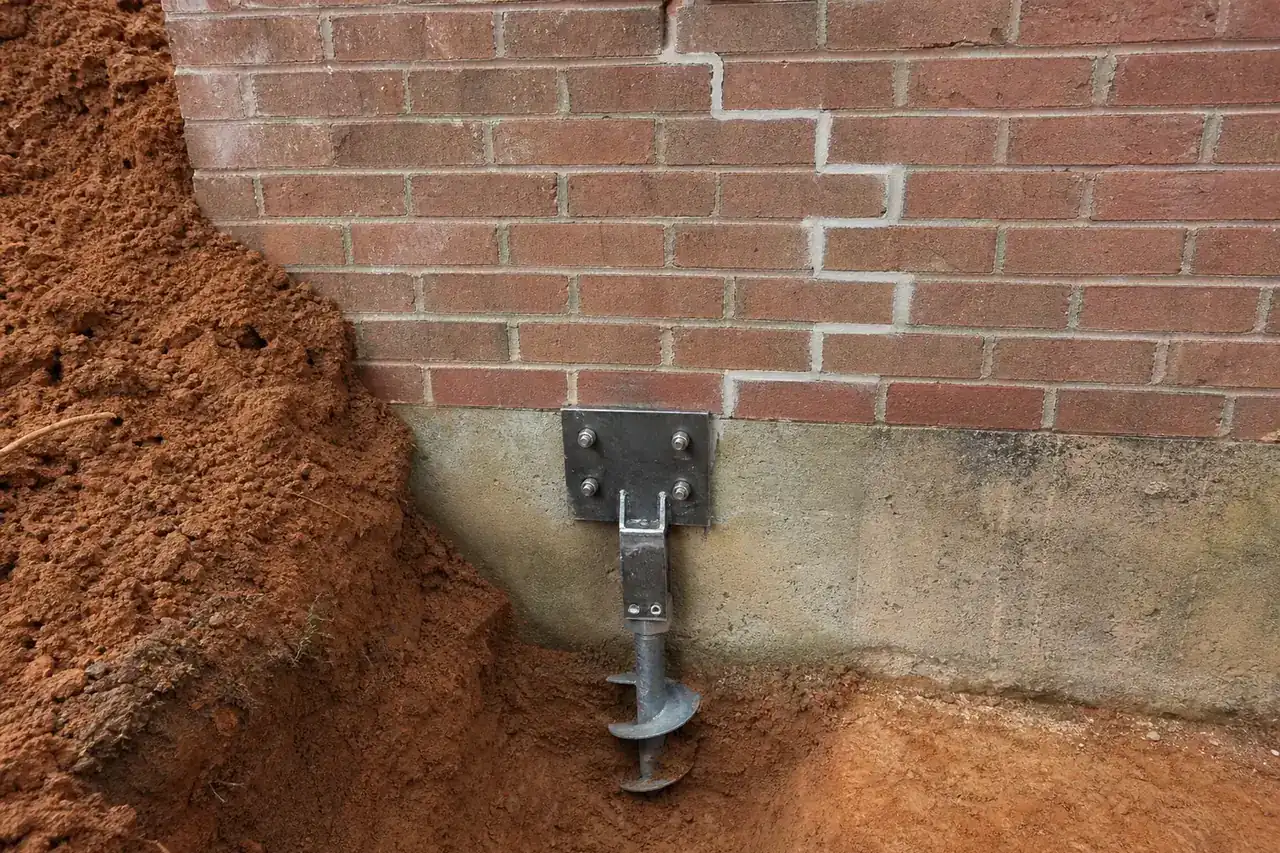
Push piers are steel tubes pressed hydraulically into the ground next to the footing, with the house itself as the counterweight, until they stop on firm soil or rock; a bracket then shifts the load onto the steel. Helical piers are screwed in with a hydraulic drive and suit lighter loads such as porches, additions and stoops. Once the piers are set, the house is jacked up in small steps and locked off.
Over a crawl space, a sagging floor is sometimes a framing problem rather than a footing problem, solved with new support posts or shims under a beam. A good assessment tells the two apart before anyone prices piers.
Level is not always the goal
Pushing a house all the way back to level can crack drywall, tile and brick that settled along with it. A careful specialist stabilizes first and lifts only as far as the structure allows. Ask what height they expect to recover and what might crack along the way. Because piers carry load, Mecklenburg County Code Enforcement's small-job permit exemption does not apply to them, so ask who pulls the permit.
What to note before the visit
Set a marble or a level on the floors and note which way they run. List the doors that stick and roughly when that started. Walk outside during a storm and see where the water goes, especially at the downhill corner. Per-pier and whole-house prices are in the foundation repair cost guide for Charlotte.
Questions homeowners ask
Will piers stop my house from settling again?
Piers that reach firm ground carry that part of the house on steel instead of on the soil near the surface, which is the point of them. Parts of the foundation without piers can still move, so ask the specialist why they chose each location and what any warranty covers.
Describe the crack, the door or the water
Say what you've noticed and where in the house. One independent foundation specialist covering Charlotte will call you back to talk it through and arrange a visit.